> For the complete documentation index, see [llms.txt](https://docs.sprinto.com/llms.txt). Markdown versions of documentation pages are available by appending `.md` to page URLs; this page is available as [Markdown](https://docs.sprinto.com/integrations/overview/gcp-integration-via-cloud-shell.md).
# GCP Integration (via Cloud Shell)
Sprinto connects to GCP through a service account. To connect Sprinto to GCP, you will need to create a service account with specific access to audit all your GCP resources. This article provides a step-by-step guide to creating the service role for GCP.
Before proceeding, please ensure that you have enough privileges to create service roles in GCP.
**Setting up the Integration:**
Step 1: Log in to [Sprinto](https://app.sprinto.in/) with your Credentials.
Step 2: Go to Settings. This is on the left-hand side bottom of the screen.
Step 3: Click on Available Integrations in the sub-menu.
Step 4: Search for GCP and click on connect next to GCP option.
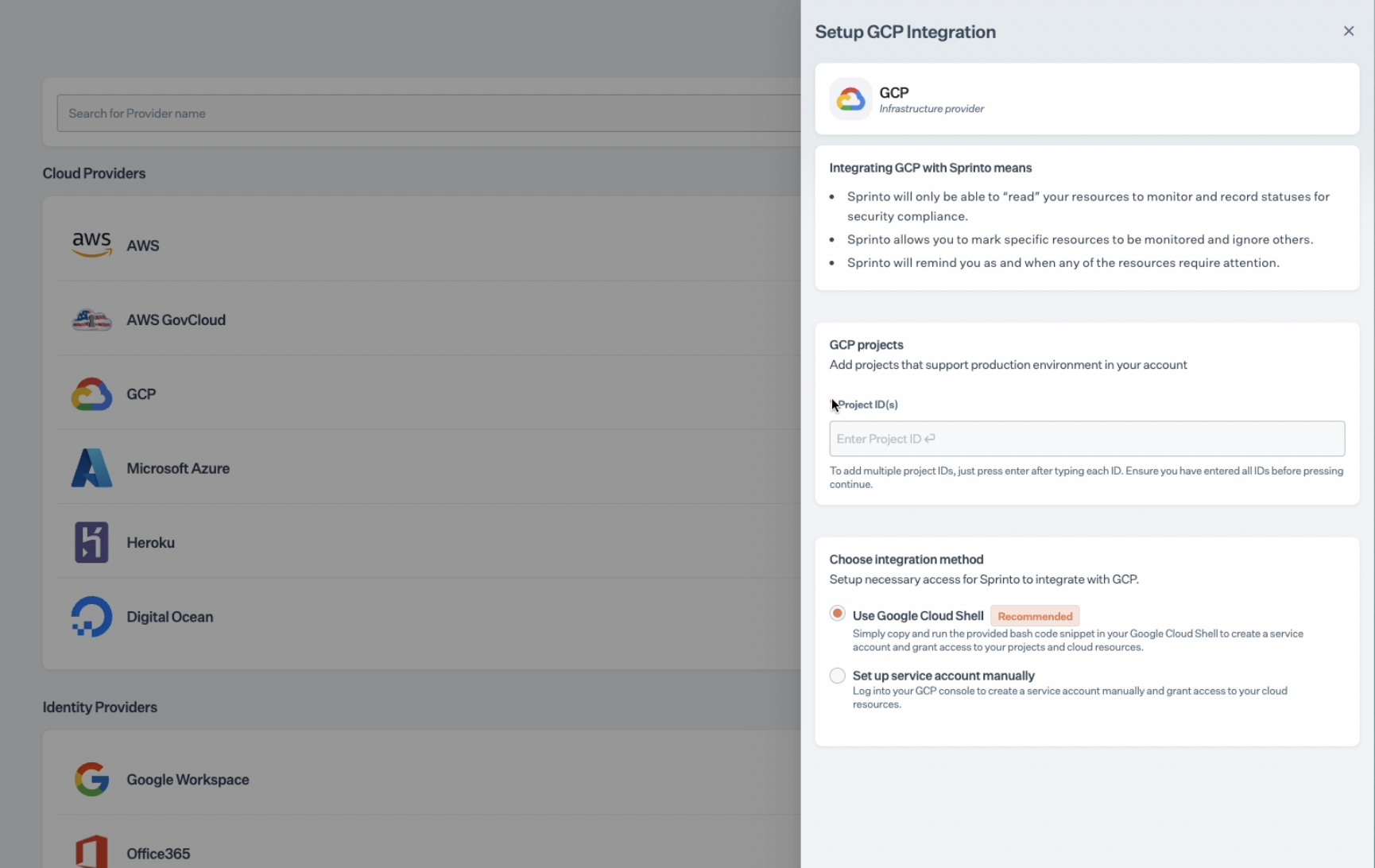
Step 5: A pop-up drawer will appear, refer to the screenshot below.
Step 6: Enter the Project IDs as requested which you would like to integrate with Sprinto, you can add multiple projects at the same time as well.
Step 7: Choose the integration method of Use Google Cloud Shell, it will be pre-selected and click on Continue.
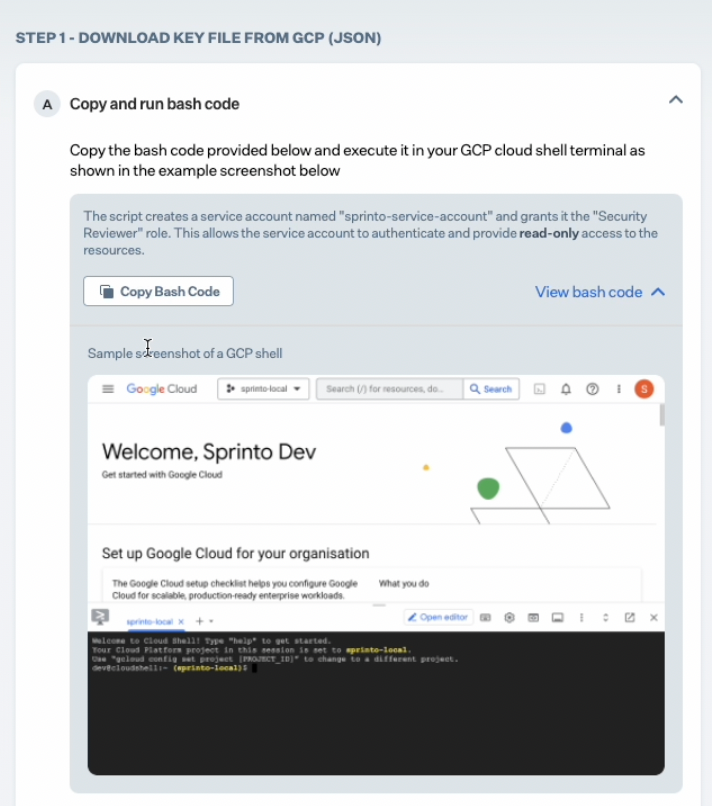
Step 8: On the next screen, you need to follow the 2 steps as mentioned below.
1. Copy and run Bash code
\- Click on the Copy Bash Code button and paste it in Google Cloud Shell and run the code.\
\- You can also view the bash code before pasting it by clicking on View bash code on the right hand side.\
\- The script creates a service account named "sprinto-service-account" and grants it the "Security Reviewer" role. This allows the service account to authenticate and provide read-only access to the resources.
\- You can open the Cloud Shell editor by opening your project in GCP and search for Google Cloud Shell, the editor will be visible at the bottom of the screen.
2. Download the Key File
\- Once the code is run, the terminal window will show a pop-up with the option to download the JSON key file.\
\- Kindly download it on your device and it will be required later.
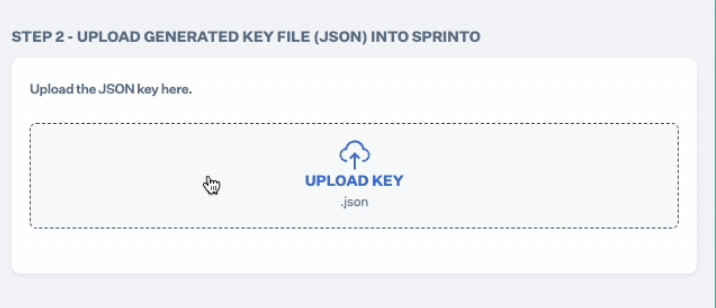
Step 9: Upload the downloaded JSON Key as requested.
Step 10: Click on Connect and the GCP integration will be set up. If you go back to GCP -> IAM, you will be able to view the service account created for Sprinto.
Congratulations! Sprinto is now connected to your GCP resources, and within the next 24 hours, you'll start receiving data and insights on the Sprinto platform. If you have any questions or concerns during the integration process, don't hesitate to reach out to your CSM for help. You may also contact Sprinto Support.
---
# Agent Instructions
This documentation is published with GitBook. GitBook is the documentation platform designed so that both humans and AI agents can read, navigate, and reason over technical content effectively. Learn more at gitbook.com.
## Querying This Documentation
If you need additional information that is not directly available in this page, you can query the documentation by asking a question.
Perform an HTTP GET request on the following URL with the `ask` and `goal` query parameters:
```
GET https://docs.sprinto.com/integrations/overview/gcp-integration-via-cloud-shell.md?ask=&goal=
```
`ask` is the immediate question: it should be specific, self-contained, and written in natural language.
`goal` is what the user is ultimately trying to achieve, the reason they need the answer. Sharing it helps GitBook give you a better, more relevant answer. A goal is most helpful when it describes the outcome the user wants rather than restating the question. For example, with `ask=how do I create an API token`, a goal like `automate deployments from our CI pipeline` lets GitBook tailor the answer to that use case.
The response will contain a direct answer to the question and relevant excerpts and sources from the documentation.
Use this mechanism when the answer is not explicitly present in the current page, you need clarification or additional context, or you want to retrieve related documentation sections.
 2. Download the Key File
\- Once the code is run, the terminal window will show a pop-up with the option to download the JSON key file.\
\- Kindly download it on your device and it will be required later.
Step 9: Upload the downloaded JSON Key as requested.
2. Download the Key File
\- Once the code is run, the terminal window will show a pop-up with the option to download the JSON key file.\
\- Kindly download it on your device and it will be required later.
Step 9: Upload the downloaded JSON Key as requested.
 Step 10: Click on Connect and the GCP integration will be set up. If you go back to GCP -> IAM, you will be able to view the service account created for Sprinto.
Congratulations! Sprinto is now connected to your GCP resources, and within the next 24 hours, you'll start receiving data and insights on the Sprinto platform. If you have any questions or concerns during the integration process, don't hesitate to reach out to your CSM for help. You may also contact Sprinto Support.
---
# Agent Instructions
This documentation is published with GitBook. GitBook is the documentation platform designed so that both humans and AI agents can read, navigate, and reason over technical content effectively. Learn more at gitbook.com.
## Querying This Documentation
If you need additional information that is not directly available in this page, you can query the documentation by asking a question.
Perform an HTTP GET request on the following URL with the `ask` and `goal` query parameters:
```
GET https://docs.sprinto.com/integrations/overview/gcp-integration-via-cloud-shell.md?ask=
Step 10: Click on Connect and the GCP integration will be set up. If you go back to GCP -> IAM, you will be able to view the service account created for Sprinto.
Congratulations! Sprinto is now connected to your GCP resources, and within the next 24 hours, you'll start receiving data and insights on the Sprinto platform. If you have any questions or concerns during the integration process, don't hesitate to reach out to your CSM for help. You may also contact Sprinto Support.
---
# Agent Instructions
This documentation is published with GitBook. GitBook is the documentation platform designed so that both humans and AI agents can read, navigate, and reason over technical content effectively. Learn more at gitbook.com.
## Querying This Documentation
If you need additional information that is not directly available in this page, you can query the documentation by asking a question.
Perform an HTTP GET request on the following URL with the `ask` and `goal` query parameters:
```
GET https://docs.sprinto.com/integrations/overview/gcp-integration-via-cloud-shell.md?ask=