> For the complete documentation index, see [llms.txt](https://docs.sprinto.com/llms.txt). Markdown versions of documentation pages are available by appending `.md` to page URLs; this page is available as [Markdown](https://docs.sprinto.com/integrations/overview/zenduty-integration.md).

# Zenduty Integration

### Introduction

The following guide will help you to integrate[ ](http://incident.io/)Zenduty with Sprinto.

Zenduty is an incident management platform designed to help teams respond to outages and disruptions efficiently. It offers features like alerting, on-call scheduling, and incident tracking to streamline incident resolution.

#### How does this Integration help

Below are the available checks for Zenduty:

<table><thead><tr><th width="169.4921875">Sprinto check</th><th>Required action</th></tr></thead><tbody><tr><td><strong>Reported incident should be closed in Zenduty</strong></td><td><p>The check fails against an incident currently in the <strong>Open</strong> status from the configured Zenduty account.<br><br>How to fix: To pass the Sprinto check, take the necessary action against the reported incident and update the incident status to Closed.</p><p>Additionally, you can declare data loss against the incident log from the Sprinto account.</p></td></tr></tbody></table>

### Before you begin

* Log in to the Sprinto admin portal using your credentials.
* You need to have administrator privilege on the Zenduty account you are integrating.
* Ensure your Zenduty account is on one of the following plans (Growth or Enterprise).

### Procedure

1. Get the API key from the Zenduty account.
   1. Log in to your[ Zenduty](https://www.zenduty.com/login/) account with your credentials or use the available SSO options.
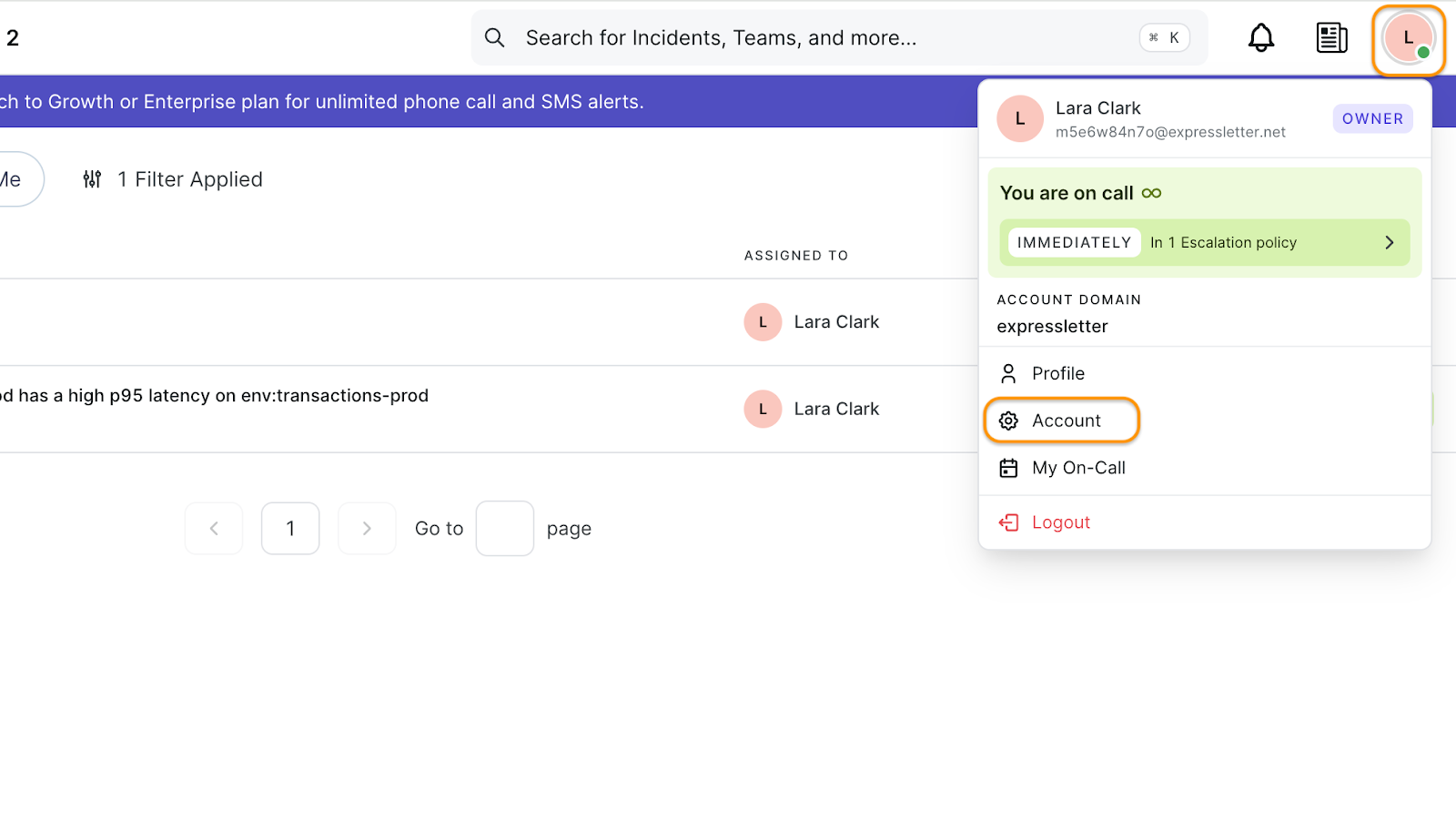
   2. Click on your profile icon at the top right corner, and click Accounts.<br>

      <figure><img src="https://s3.amazonaws.com/cdn.freshdesk.com/data/helpdesk/attachments/production/72116786018/original/m_NrTktojTFuQs2Qyhslb6ACEM9j6LrD7g.png?1727267506" alt="" width="563"><figcaption></figcaption></figure>
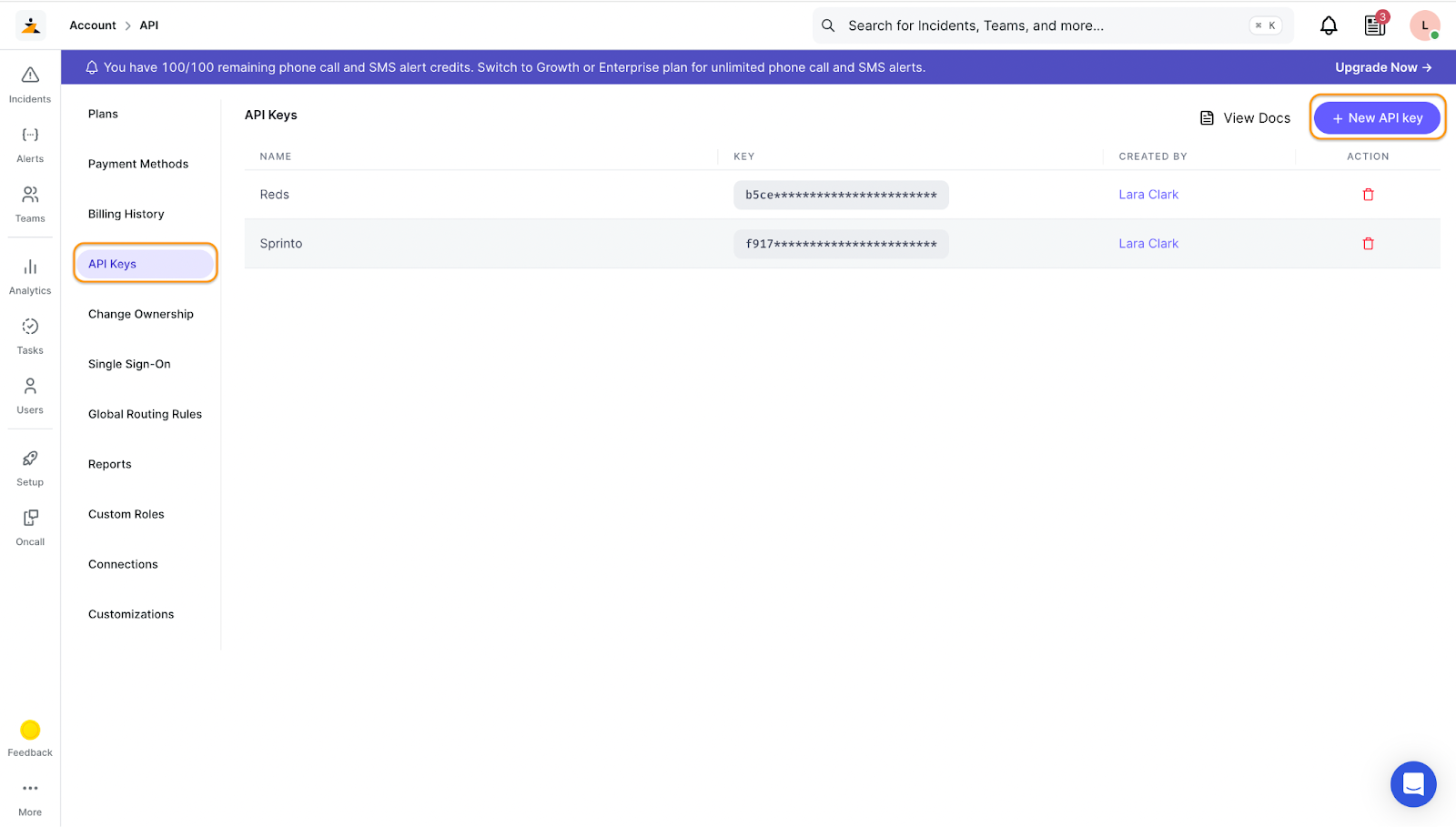
   3. Click API keys from the left-side navigation bar.
   4. Click New API key to generate a new API key.<br>

      <figure><img src="https://s3.amazonaws.com/cdn.freshdesk.com/data/helpdesk/attachments/production/72116786040/original/iRf-LWKEzhqTC4zA44tfXvlGQkqNffxl3Q.png?1727267514" alt="" width="563"><figcaption></figcaption></figure>
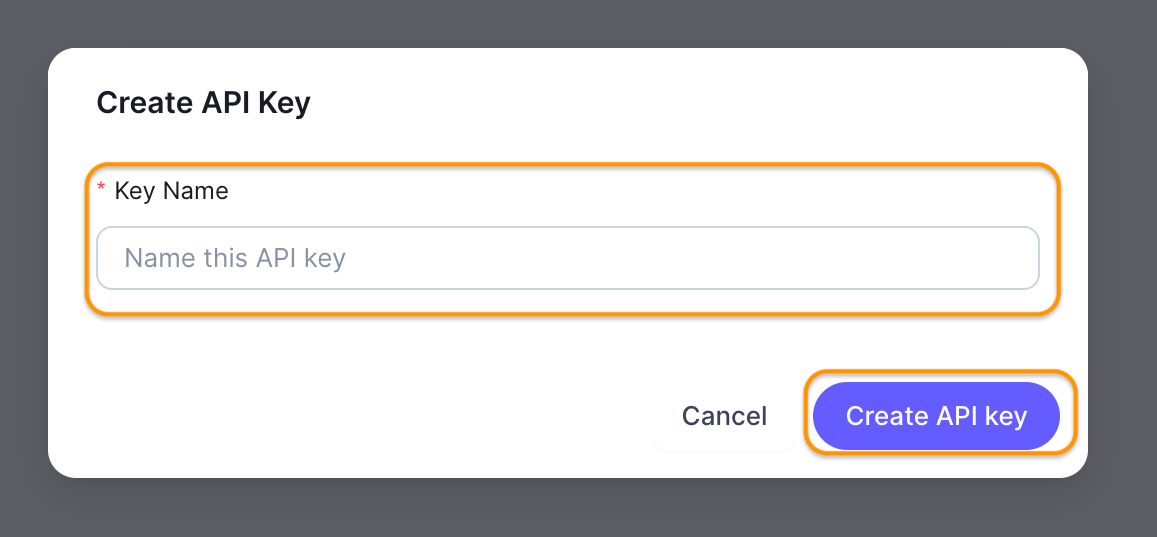
   5. Enter an appropriate name for the key, and click Create API key.<br>

      <figure><img src="https://s3.amazonaws.com/cdn.freshdesk.com/data/helpdesk/attachments/production/72116786013/original/RtIEifyLifc-hcX-PXBudQZbtBj8_qvnEA.png?1727267506" alt="" width="563"><figcaption></figcaption></figure>
   6. Copy the generated API key and save it securely. We will need this key later to build integration with Sprinto. \
      Note: Ensure you copy the API key before closing the window. Once closed, the API key cannot be retrieved and needs to be generated again.
2. Integrate Zenduty with Sprinto.
   1. From the Sprinto admin portal, navigate to **Settings** > **Integrations**, and select the Available tab.
   2. Click Connect next to **Zenduty**.

      <figure><img src="/files/uFkMKjc241hU76BzQRvO" alt="" width="563"><figcaption></figcaption></figure>
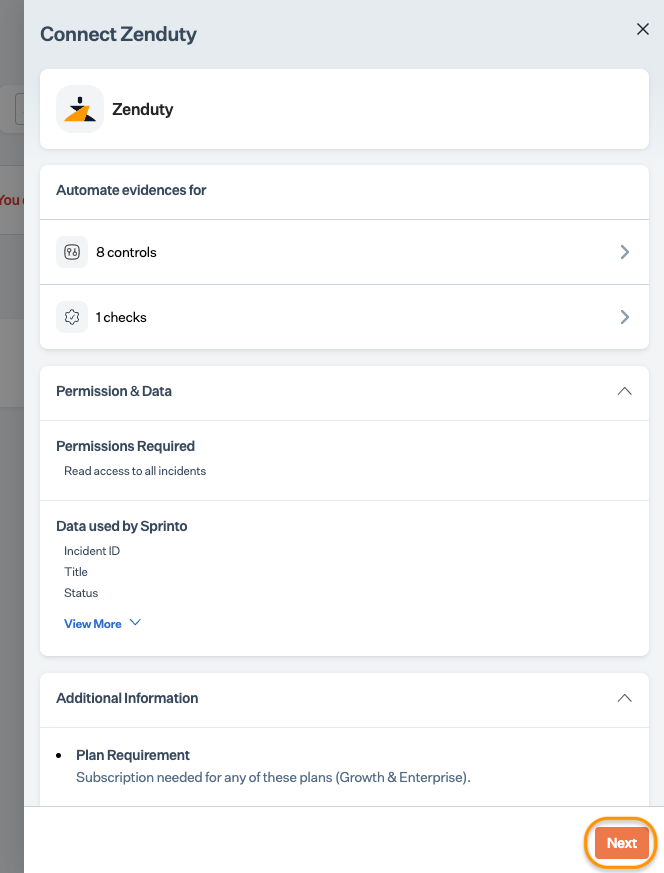
   3. Read the on-screen instructions, and click Next.<br>

      <figure><img src="https://s3.amazonaws.com/cdn.freshdesk.com/data/helpdesk/attachments/production/72116786014/original/fyyzn8meHpEY7_fdYm68rjqGD-u7WAHM8A.png?1727267506" alt="" width="375"><figcaption></figcaption></figure>
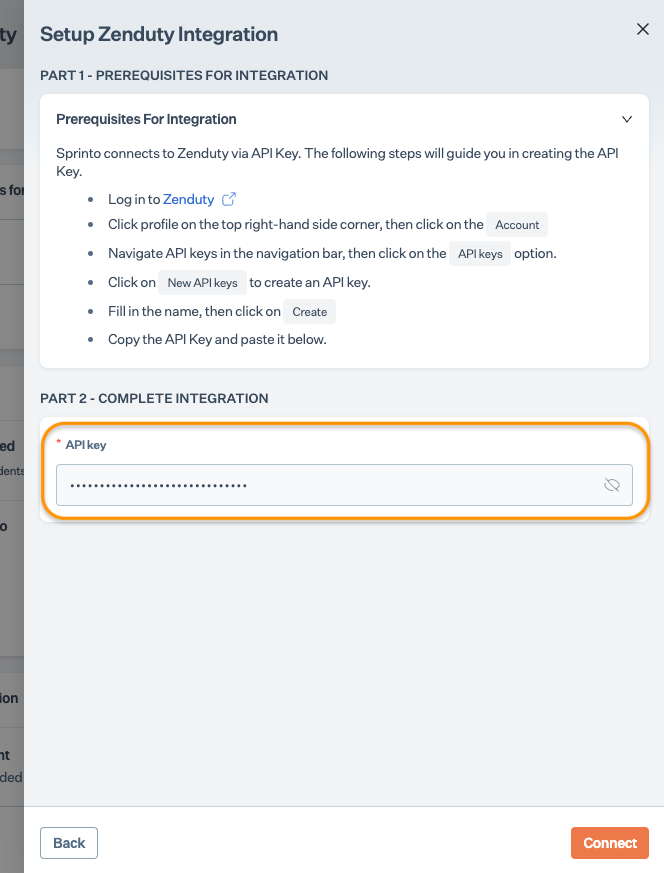
   4. Enter your Zenduty API key from Step 1, and click Connect.<br>

      <figure><img src="https://s3.amazonaws.com/cdn.freshdesk.com/data/helpdesk/attachments/production/72116786019/original/_zja9weBeyGrsPw9Fih-HRgOx7IDJM09aw.png?1727267507" alt="" width="375"><figcaption></figcaption></figure>
3. Add Zenduty as an incident management system.
   1. Navigate to Data Library > Incident > Overview, and click Add system.
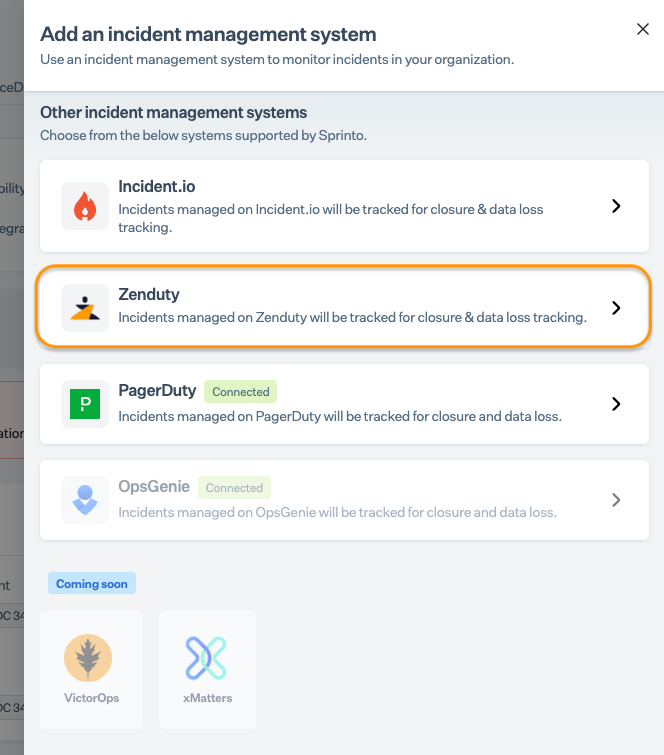
   2. Select Zenduty from the Add an Incident Management System page. \
      Note: “Connected” is highlighted next to integrated systems.<br>

      <figure><img src="https://s3.amazonaws.com/cdn.freshdesk.com/data/helpdesk/attachments/production/72116786015/original/sWWxVKSnI7P0PpwCtL9MPic82Af4zko6Wg.png?1727267506" alt="" width="375"><figcaption></figcaption></figure>
   3. Follow the on-screen instructions and complete the system configuration. Note: Once configured, wait until Sprinto finishes the data syncing. The waiting time depends on the data size to be synced.
4. Review the retrieved incident details.
   1. To review the incident details, navigate to Data Library > Incidents and select the Zenduty tab.
   2. Review the incident details. You can find the incidents in various statuses.
   3. Resolve the incidents and take the necessary steps. Update the incident status on the Zenduty account. \
      Note: Sprinto syncs the status chance for an incident and sets the assigned Sprinto check status to “Passing.”
   4. If the reported incident highlights any data loss, update the data loss on Sprinto against the incident. Refer to[ handling data loss reporting](https://sprinto.freshdesk.com/support/solutions/articles/72000634709-handling-incident-ticketing-and-data-loss-reporting) for detailed instructions.

### Support

Get in touch with our [support team](mailto:www.support@sprinto.com) if you have any quiries related to the integration or need any support.


---

# Agent Instructions
This documentation is published with GitBook. GitBook is the documentation platform designed so that both humans and AI agents can read, navigate, and reason over technical content effectively. Learn more at gitbook.com.

## Querying This Documentation
If you need additional information that is not directly available in this page, you can query the documentation dynamically by asking a question.

Perform an HTTP GET request on the current page URL with the `ask` query parameter:

```
GET https://docs.sprinto.com/integrations/overview/zenduty-integration.md?ask=<question>
```

The question should be specific, self-contained, and written in natural language.
The response will contain a direct answer to the question and relevant excerpts and sources from the documentation.

Use this mechanism when the answer is not explicitly present in the current page, you need clarification or additional context, or you want to retrieve related documentation sections.