# Custom Fields

The **Custom Fields** section in Sprinto allows you to store additional information about your entities, such as vendors, risks, and policies. By defining custom attributes, you can capture data that is not available in Sprinto’s default fields. This flexibility ensures that your organisation’s unique compliance and operational requirements are met.

You can:

* Create new custom fields.
* Manage existing custom fields.
* Edit field properties and availability.
* Define calculation logic using formula fields.

Custom fields can be used across various modules in Sprinto, such as Risks, Policies & Documents, Vendors, and more.

***

### Accessing Custom Fields

1. Log in to the Sprinto dashboard.
2. From the left navigation menu, go to **Settings**.
3. Select **Custom fields**.
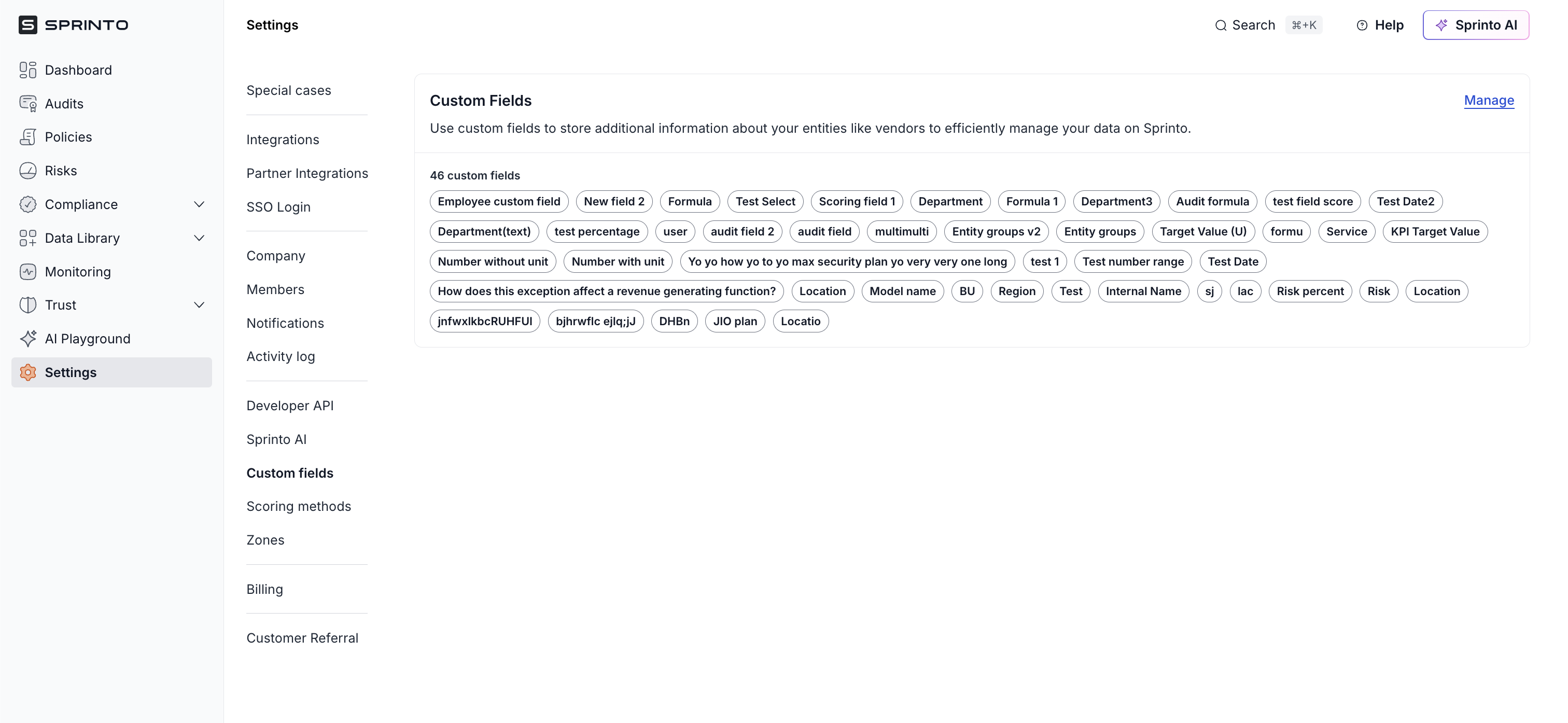
4. The page displays all custom fields in your organisation, along with their names, types, and assigned modules.

<figure><img src="https://3220032727-files.gitbook.io/~/files/v0/b/gitbook-x-prod.appspot.com/o/spaces%2FEsyn5VMU6e0OyGjRtKgx%2Fuploads%2FuoF0WvLCMmhlKBBkXdYT%2FScreenshot%202025-10-30%20at%2014.37.48.png?alt=media&#x26;token=3f16f141-d16f-4602-987a-df47f9d4f73f" alt="" width="563"><figcaption></figcaption></figure>

***

### Managing Custom Fields

1. On the **Custom Fields** page, click **Manage**.
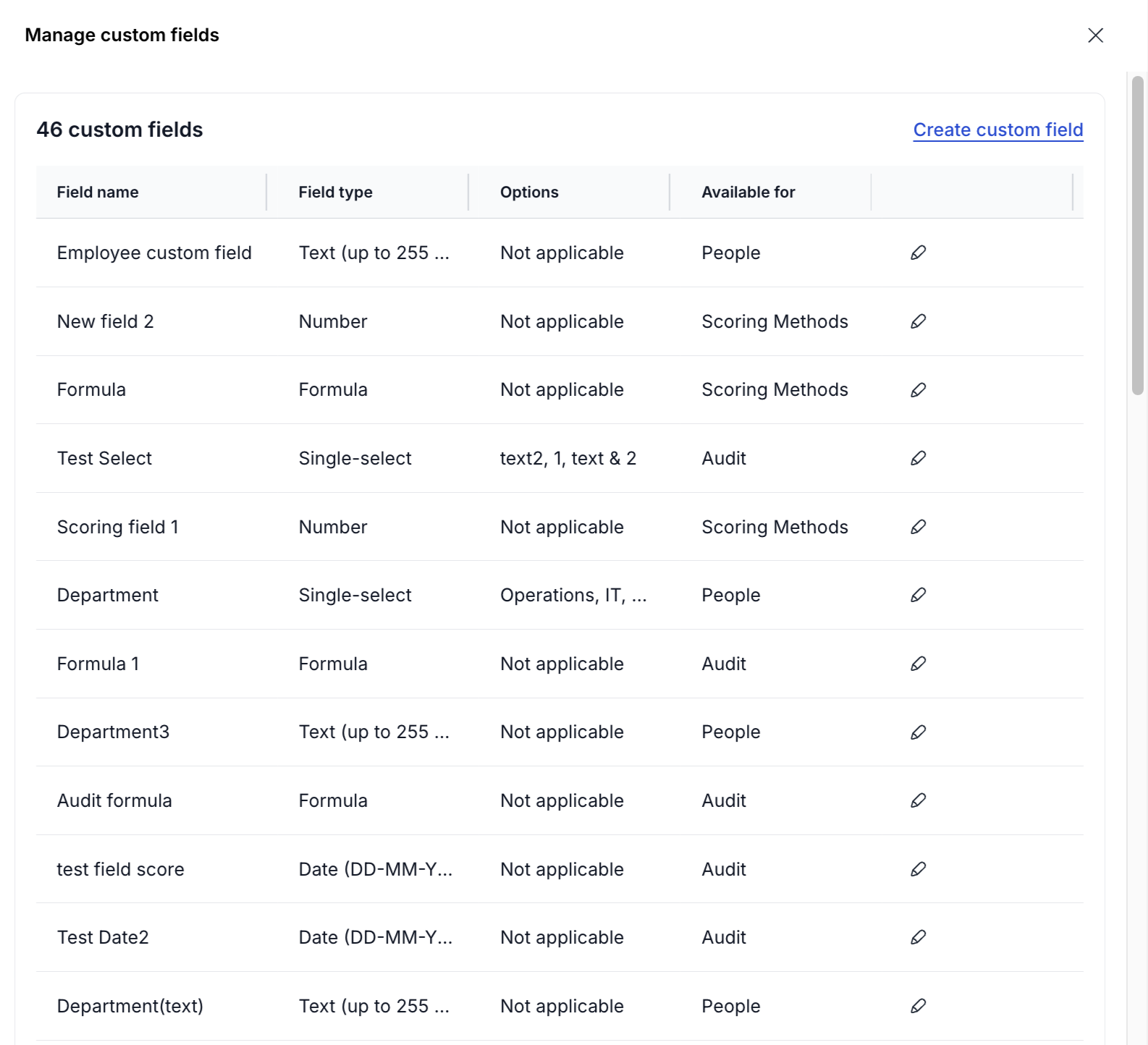
2. The **Manage custom fields** drawer opens, listing:
   * **Field name**: The display name of the field.
   * **Field type**: The type of input or calculation (e.g., Text, Number, Formula, Single-select, Percentage).
   * **Options**: Applicable only for certain types such as Single-select or Multi-select.
   * **Available for**: Indicates which Sprinto modules the field is linked to.
3. Use the **Edit** icon next to a field to update its details.

<figure><img src="https://3220032727-files.gitbook.io/~/files/v0/b/gitbook-x-prod.appspot.com/o/spaces%2FEsyn5VMU6e0OyGjRtKgx%2Fuploads%2FzyrE3K3jzRf8W6MsdoiG%2FScreenshot%202025-10-30%20at%2014.40.58.png?alt=media&#x26;token=bd64036d-4d3b-477f-b32b-71488ca7d666" alt="" width="563"><figcaption></figcaption></figure>

***

### Creating a Custom Field

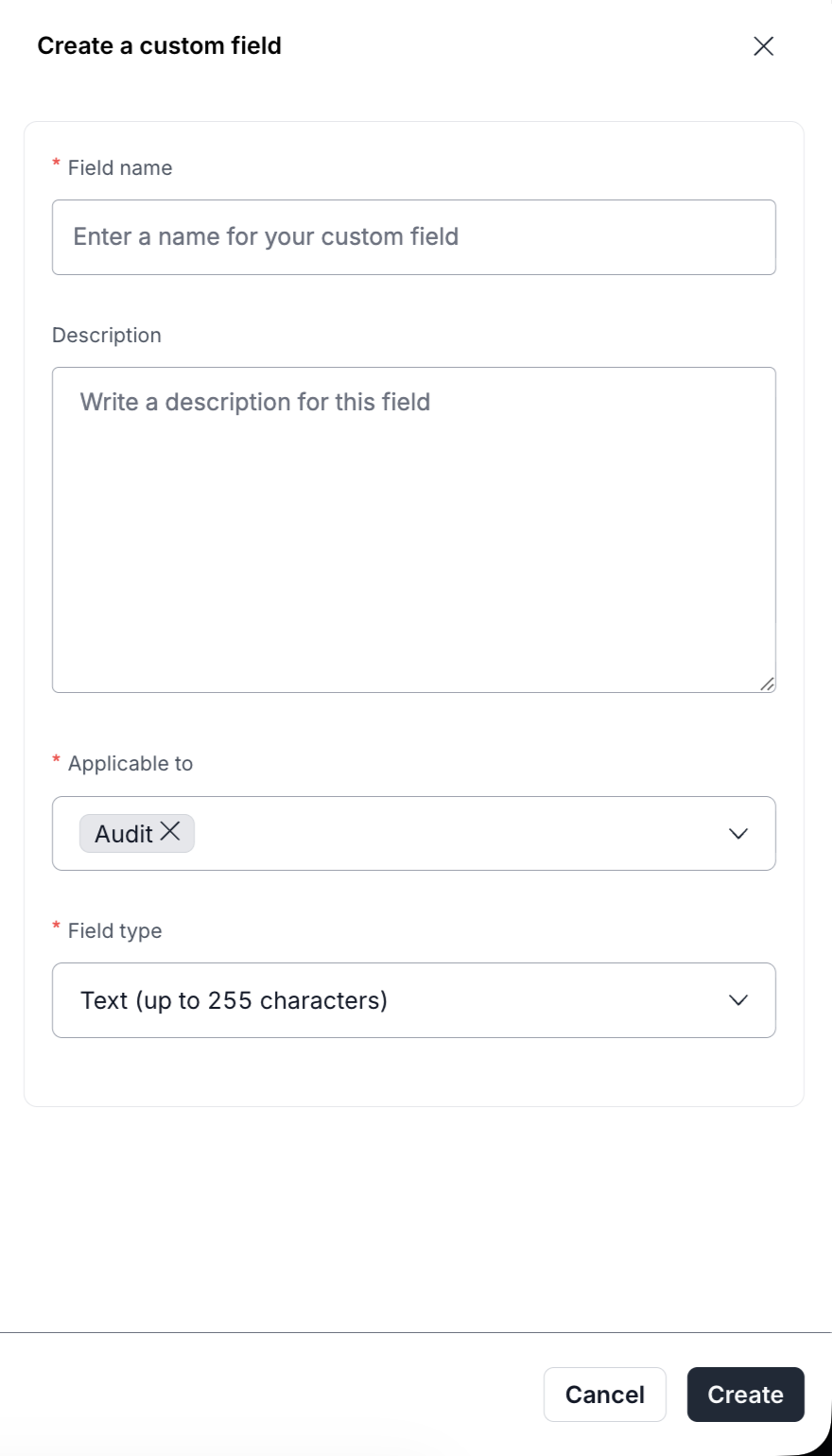
1. In the **Manage custom fields** drawer, click **Create custom field**.
2. Enter the **Field name**.
3. (Optional) Add a description to provide context.
4. Select the **Applicable to** module (e.g., Risks, Vendors, Policies & Docs).

<figure><img src="https://3220032727-files.gitbook.io/~/files/v0/b/gitbook-x-prod.appspot.com/o/spaces%2FEsyn5VMU6e0OyGjRtKgx%2Fuploads%2FpYtIlSBQgALCrrt1NrJX%2FScreenshot%202025-10-30%20at%2014.49.33.png?alt=media&#x26;token=58fb17c5-c8dd-49b8-a32f-7931cee22cc1" alt="" width="375"><figcaption></figcaption></figure>

5. Choose the **Field type** from the available options:
   * **Text** (single or multi-line)
   * **Number**
   * **Percentage**
   * **Date**
   * **Single-select**
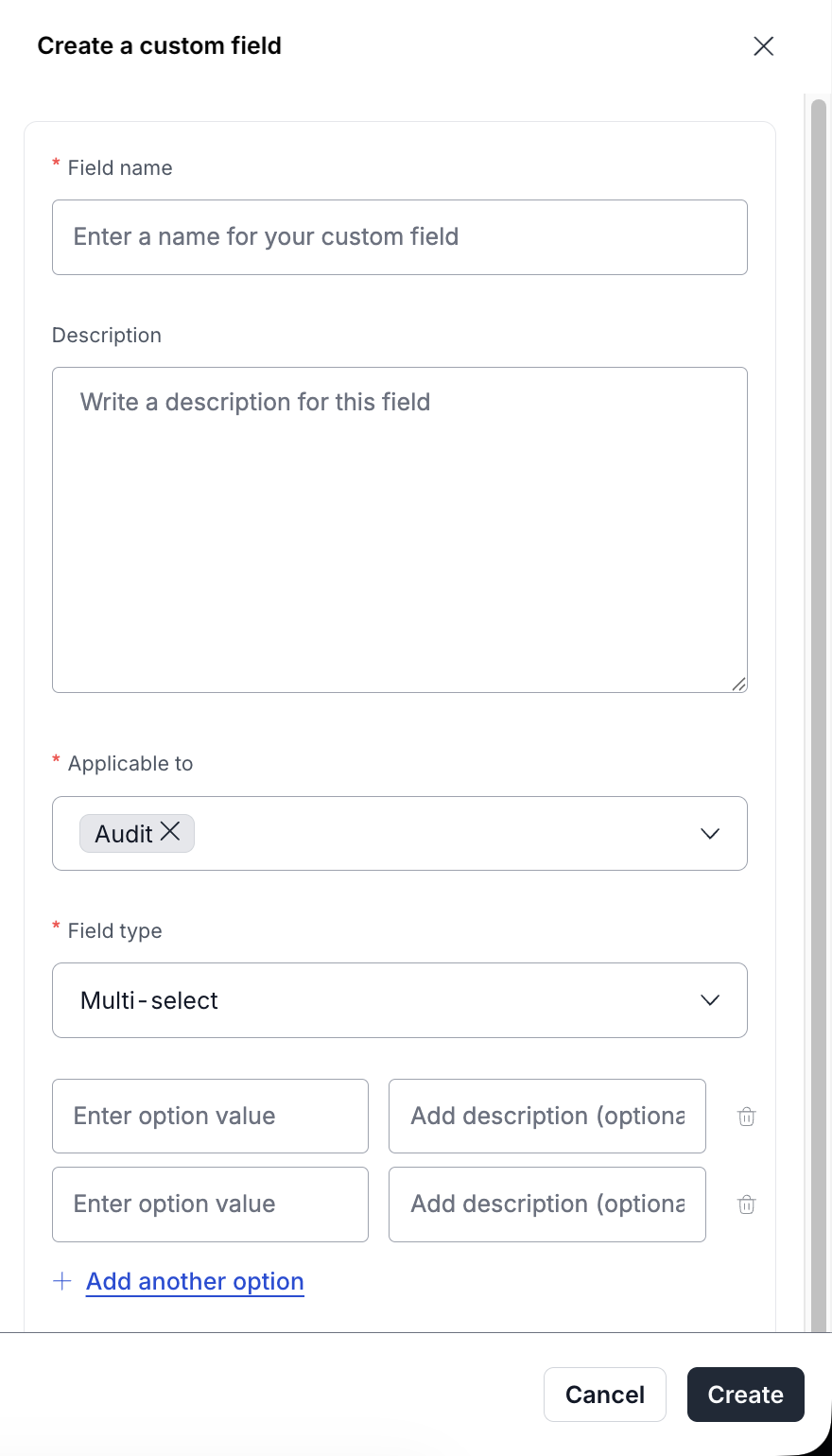
   * **Multi-select**
   * **Formula** (supports mathematical operations using other fields)
6. (If applicable) Add selectable **Options**.
7. For Formula fields, use the builder to add fields, operators, and constants. The system validates your formula in real time.
8. Enable or disable the field status as required.
9. Click **Create** to save.

<figure><img src="https://3220032727-files.gitbook.io/~/files/v0/b/gitbook-x-prod.appspot.com/o/spaces%2FEsyn5VMU6e0OyGjRtKgx%2Fuploads%2FPK7OzXkUidPsf2QiUOsn%2FScreenshot%202025-10-30%20at%2014.50.24.png?alt=media&#x26;token=a3f4d846-b2ae-49ed-80d3-d249fad0596c" alt="" width="375"><figcaption></figcaption></figure>

***

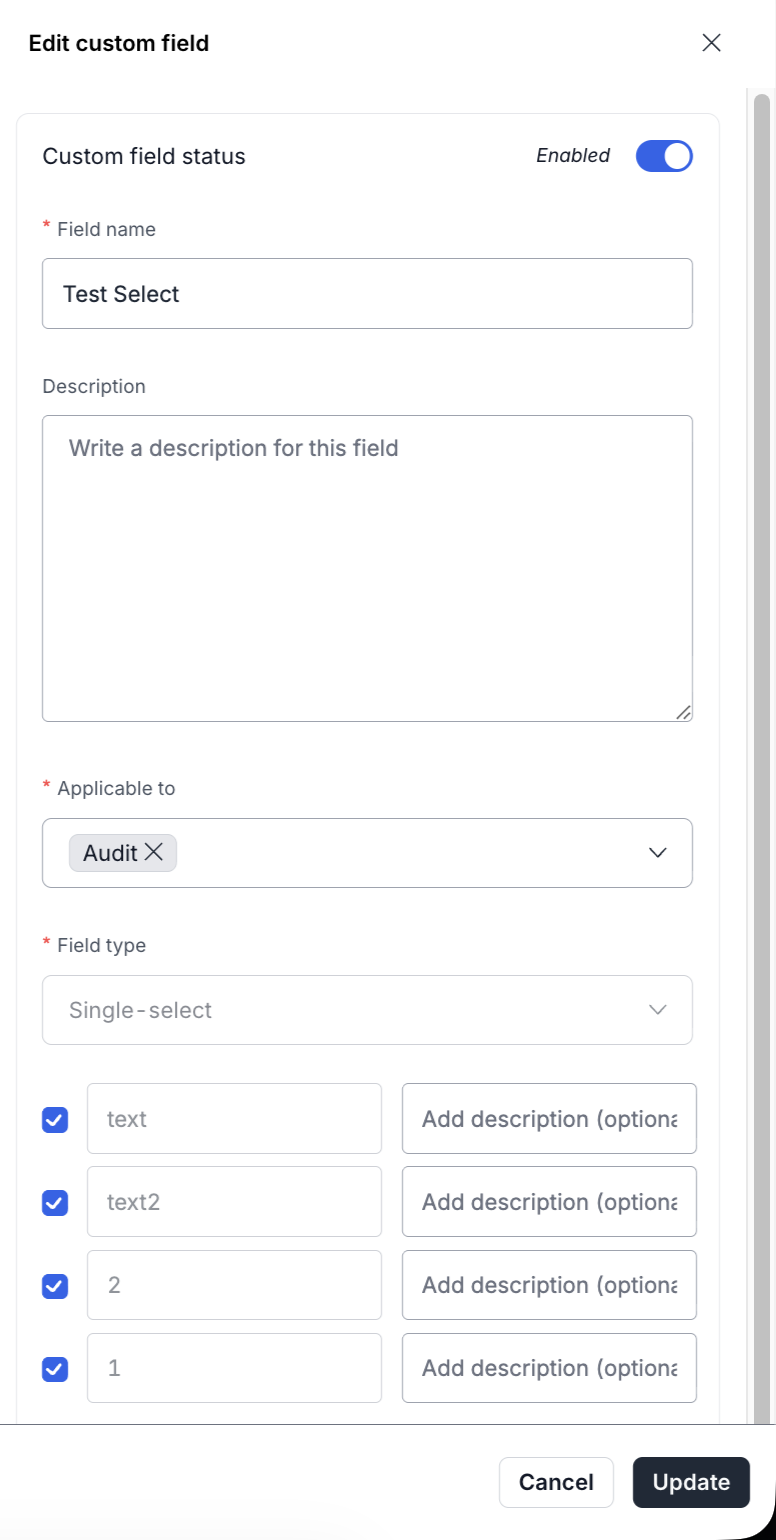
### Editing a Custom Field

1. In the **Manage custom fields** drawer, click the **Edit** icon next to the field you want to update.
2. Modify the name, description, applicable module, type, options, or formula.
3. Save changes by clicking **Update**.

<figure><img src="https://3220032727-files.gitbook.io/~/files/v0/b/gitbook-x-prod.appspot.com/o/spaces%2FEsyn5VMU6e0OyGjRtKgx%2Fuploads%2F5rbRXbfkLJMWbyZENkix%2FScreenshot%202025-10-30%20at%2014.51.05.png?alt=media&#x26;token=4d991150-e1b3-495f-b806-87ff276d32e5" alt="" width="375"><figcaption></figcaption></figure>

***

### Field Types Overview

<table><thead><tr><th width="120.58203125">Field Type</th><th width="372.90234375">Description</th><th>Example Use Case</th></tr></thead><tbody><tr><td>Text</td><td>Accepts free-form text (single or multiple lines).</td><td>Department name, project code</td></tr><tr><td>Number</td><td>Accepts numeric values.</td><td>Risk ID, employee count</td></tr><tr><td>Percentage</td><td>Accepts values in percentage format.</td><td>Risk treatment completion</td></tr><tr><td>Date</td><td>Accepts date inputs.</td><td>Policy expiry date</td></tr><tr><td>Single-select</td><td>Allows selection of one value from predefined options.</td><td>Risk severity levels</td></tr><tr><td>Multi-select</td><td>Allows selection of multiple predefined options.</td><td>Applicable frameworks</td></tr><tr><td>Formula</td><td>Uses operators and other field values to calculate outputs.</td><td>Risk score calculation</td></tr></tbody></table>

***

### Best Practices

* Use descriptive field names to improve clarity.
* Document formula logic for future reference.
* Assign fields only to relevant modules to avoid clutter.
* Regularly review and disable unused fields to maintain data hygiene.