> For the complete documentation index, see [llms.txt](https://docs.sprinto.com/llms.txt). Markdown versions of documentation pages are available by appending `.md` to page URLs; this page is available as [Markdown](https://docs.sprinto.com/data-library/change-management/dashboard-actions/classify-code-repositories.md).
# Classify Code Repositories
### **About:**
The procedure below describes classifying code repositories in the integrated code repository systems. Classifying the code repositories that directly contribute to the service or product is mandatory per the security framework requirement.
### **Prerequisites:**
* Logged in on Sprinto as an administrator.
* Code repositories systems are set up on Sprinto. Refer to [How to Set Up Code Repositories On Sprinto?](/data-library/change-management/dashboard-actions/adding-and-editing-change-management-systems.md).
### **Procedure:**
1. Navigate to **Data Library** > **Change Management**, then click on the code repository system whose repositories you want to classify.
2. Click on **Manage** for the repository you want to classify.
{% hint style="info" %}
By default, repositories tracked from repository systems are not classified. A monitor is activated for all non-classified repositories, and users must classify the repository to pass the check.
{% endhint %}
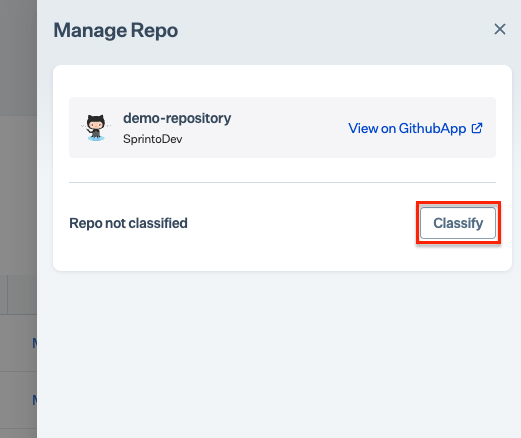
3. On manage repo page, click on **Classify.**
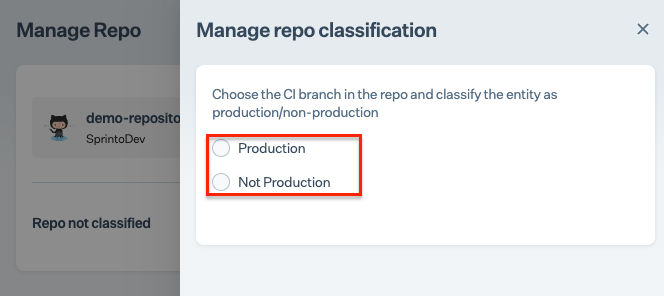
4. On manage repo classification page, select one of the following options to classify the selected repository.
* **Production**: If the stored code on the repository contributes directly to the service or product.
* **Not Production:** If the stored code on the repository is not directly contributing to the product’s functionality.
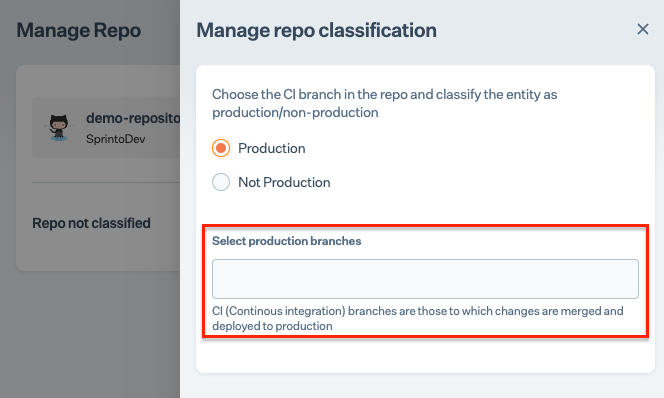
5. If you have classified the repository as “Production,” select the branches of the repository to be considered under the CI.
{% hint style="info" %}
CI stands for Continuous Integration branches. These are branches that merge changes and deploy them to production.
{% endhint %}
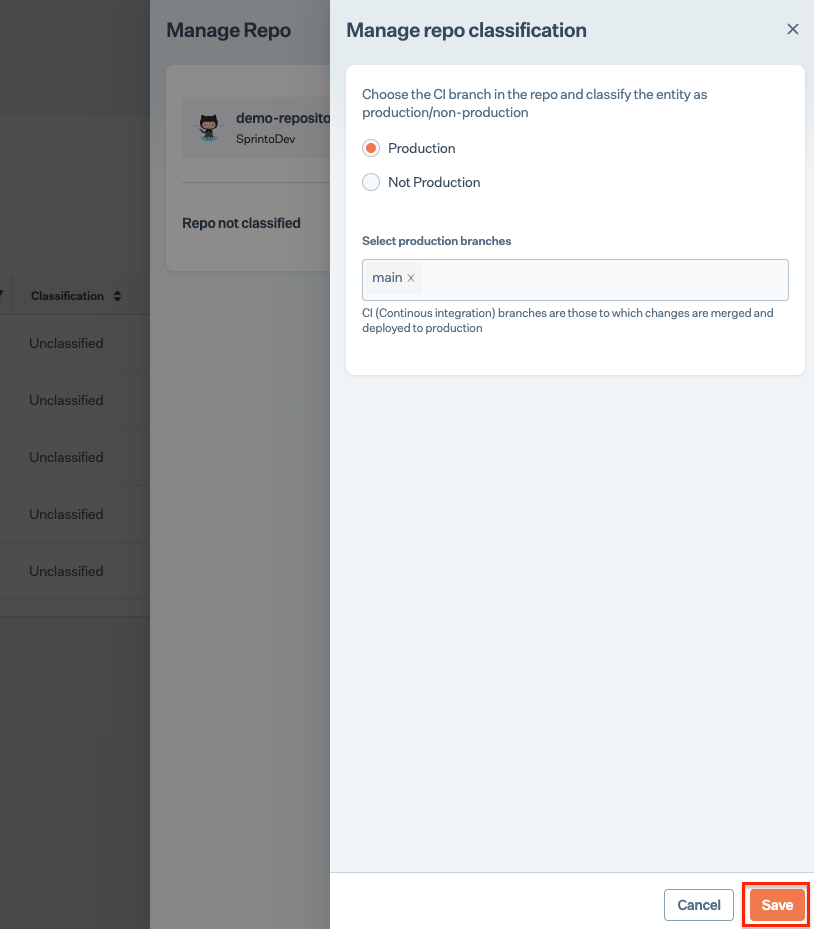
6. Click on **Save.**
### **Result:**
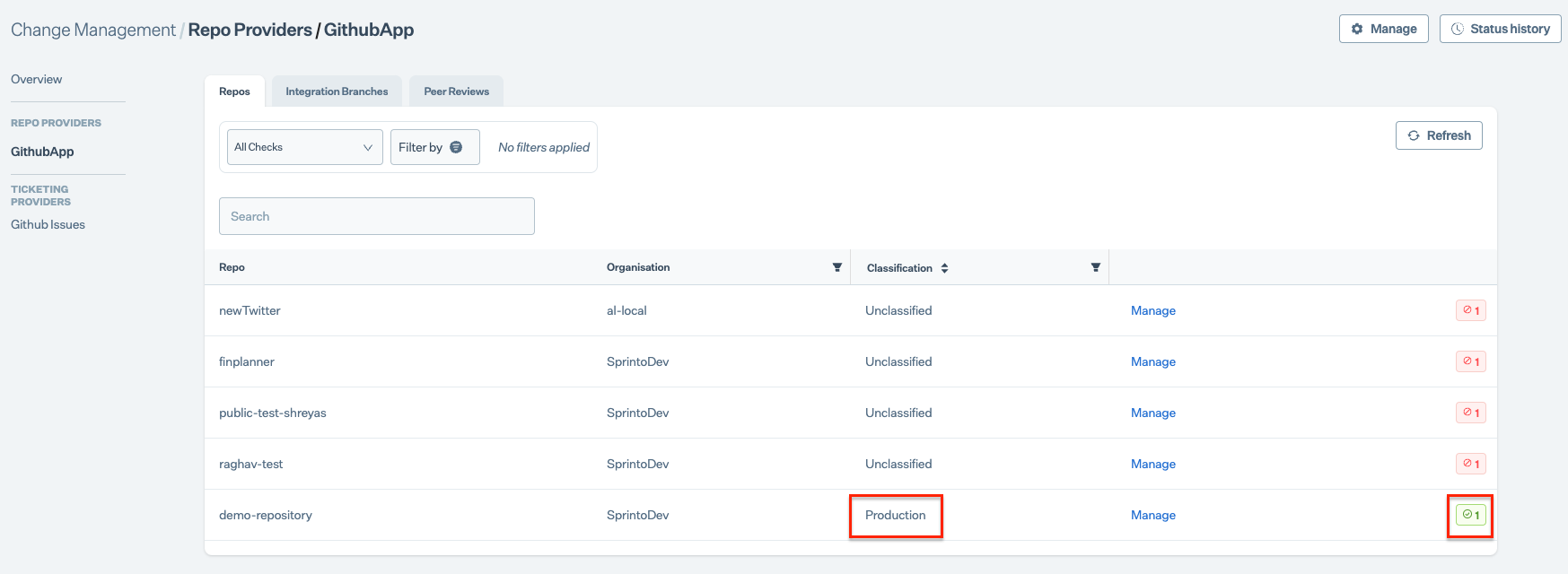
Once a repository has been successfully classified, you can view its classification status and check against the repository in “Passing” status.
---
# Agent Instructions
This documentation is published with GitBook. GitBook is the documentation platform designed so that both humans and AI agents can read, navigate, and reason over technical content effectively. Learn more at gitbook.com.
## Querying This Documentation
If you need additional information that is not directly available in this page, you can query the documentation by asking a question.
Perform an HTTP GET request on the following URL with the `ask` and `goal` query parameters:
```
GET https://docs.sprinto.com/data-library/change-management/dashboard-actions/classify-code-repositories.md?ask=&goal=
```
`ask` is the immediate question: it should be specific, self-contained, and written in natural language.
`goal` is what the user is ultimately trying to achieve, the reason they need the answer. Sharing it helps GitBook give you a better, more relevant answer. A goal is most helpful when it describes the outcome the user wants rather than restating the question. For example, with `ask=how do I create an API token`, a goal like `automate deployments from our CI pipeline` lets GitBook tailor the answer to that use case.
The response will contain a direct answer to the question and relevant excerpts and sources from the documentation.
Use this mechanism when the answer is not explicitly present in the current page, you need clarification or additional context, or you want to retrieve related documentation sections.