> For the complete documentation index, see [llms.txt](https://docs.sprinto.com/llms.txt). Markdown versions of documentation pages are available by appending `.md` to page URLs; this page is available as [Markdown](https://docs.sprinto.com/risks/dashboard-actions/edit-a-risk.md).
# Edit a Risk
Sprinto allows users to edit risk details during different stages of the risk lifecycle. This helps ensure that your risk register remains accurate and up to date as your organisation evolves.
### Access a Risk Entry
1. Log in to the Sprinto dashboard and navigate to **Risks**.
2. Click on the **Risk Register** tab.
3. Locate and click the name of the risk you want to update.
4. Click Edit to start editing the details.
***
### Editable Fields
Depending on the risk’s current status, the following elements can be edited:
#### General Risk Information
* Risk scenario
* Risk owner
* Applicable CIA
* Risk source
* Risk managers
* Exposed threats
* Exposed vulnerabilities
* Monetary Value
* Additional information
To edit these:
1. Click the **Edit** icon in the top-right of the risk details section.
2. Update the required fields.
3. Click **Save and close**.
#### Scoring Parameters
* Inherent Likelihood & Impact
* Residual Likelihood & Impact
* Notes related to scoring decisions
{% hint style="info" %}
Scoring can only be edited before approval or during a new assessment cycle.
{% endhint %}
#### Treatment Plan
* Change treatment approach (Accept, Transfer, Avoid, Further Mitigate)
* Update treatment reason or notes
To make these changes:
1. Navigate to the **Treatment** tab inside the risk.
2. Click **Edit Treatment Plan**.
3. Apply your changes and save.
#### Control Mappings
* Add or remove mapped controls
To update:
1. Navigate to the **Controls** tab.
2. Use **+ Map Controls** or click the bin icon to remove.
#### Risk Treatment Tasks
* Edit task name, assignee, or due date
* Add or update task notes.
{% hint style="info" %}
All task edits are version-controlled and captured in the audit trail.
{% endhint %}
***
### Edit Risk Scores
You can update a risk's inherent risk, residual risk, and treatment plan directly from the risk details drawer. Sprinto automatically recalculates the associated scores based on the values you enter.
#### To edit risk scores
1. Log in to the Sprinto dashboard.
2. Go to **Risks** and open the required **Risk Register**.
3. Select the risk that you want to update.
4. In the risk details drawer, hover over **Inherent risk** or **Residual risk** and click **Edit**.
5. Update the required values:
* **Inherent risk**: Select the **Inherent impact** and **Inherent likelihood**.
* **Residual risk**: Select the **Residual impact** and **Residual likelihood**.
6. Review the calculated risk score and click **Save**.
#### Update the treatment plan
1. In the risk details drawer, hover over **Treatment** and click **Edit**.
2. Select the required treatment option:
* **Accept**
* **Transfer**
* **Mitigate**
* **Avoid**
3. (Optional) Add treatment notes to provide additional context.
4. Click **Save**.
{% hint style="info" %}
#### Note
Sprinto automatically recalculates the effective residual score and treatment effectiveness after you update the inherent risk, residual risk, or treatment plan.
{% endhint %}
***
### Customise your risk data table
Sprinto lets you tailor the risk data table to match how you review and manage risks. You can choose which columns are visible and reorder them to focus on the information that matters most to your workflow.
#### Customise visible columns
1. Open the required risk register.
2. In the risk table, select the **Configure columns** icon.
3. Review the list of available columns:
* Columns under **Visible columns** are currently shown in the table.
* Columns under **Hidden columns** are not shown.
4. To show or hide a column, select the **eye** icon next to the column name.
#### Reorder columns
1. In the **Configure columns** panel, locate the column you want to move.
2. Select and hold the **grid** icon next to the column name.
3. Drag the column to the required position in the list.
#### Save your view
* Select **Save** to apply your changes to the risk data table.
* The updated column order and visibility are applied immediately.
#### Key notes
* Column customisation applies only to the current view.
* You can revisit **Configure columns** at any time to update the table layout.
* Hidden columns do not affect risk data; they are only removed from view.
***
#### Bulk actions on the risk table
Bulk actions let you update or manage multiple risk scenarios at once, helping you save time when applying the same change across several risks.
#### Actions you can perform
When you select multiple risks, you can perform the following bulk actions:
* Update risk owner
* Update risk approvers
* Update risk type
* Update risk category
* Update risk treatment decision
* Run Compliance Gap Analysis
* Archive risks
* Delete risks
#### How it works
1. Navigate to **Risks** and open the required risk register.
2. In the risk data table, use the **checkboxes** to select one or more risks.
3. Once selected, a bulk action bar appears at the top of the table.
4. Choose the required action and complete the update in the confirmation dialog.
**Examples:**
* **Updating risk owner:**\
Select multiple risks and click **Update risk owner**. In the dialog that opens, choose the new risk owner and click **Update**. The selected risks are immediately reassigned to the chosen owner.
* **Running Compliance Gap Analysis:**\
Select multiple risks and click **Compliance Gap Analysis**. Review the details in the confirmation dialog and click **Confirm** to run the analysis for all selected risks at once.
* **Archiving or deleting risks:**\
Select one or more risks and choose **Archive risks** or **Delete risks** from the bulk actions menu. Confirm the action in the dialog to apply it to all selected risks simultaneously.
{% hint style="warning" %}
#### Important
Deleting risks permanently removes them from the register and cannot be undone.
{% endhint %}
***
#### Customise risk charts
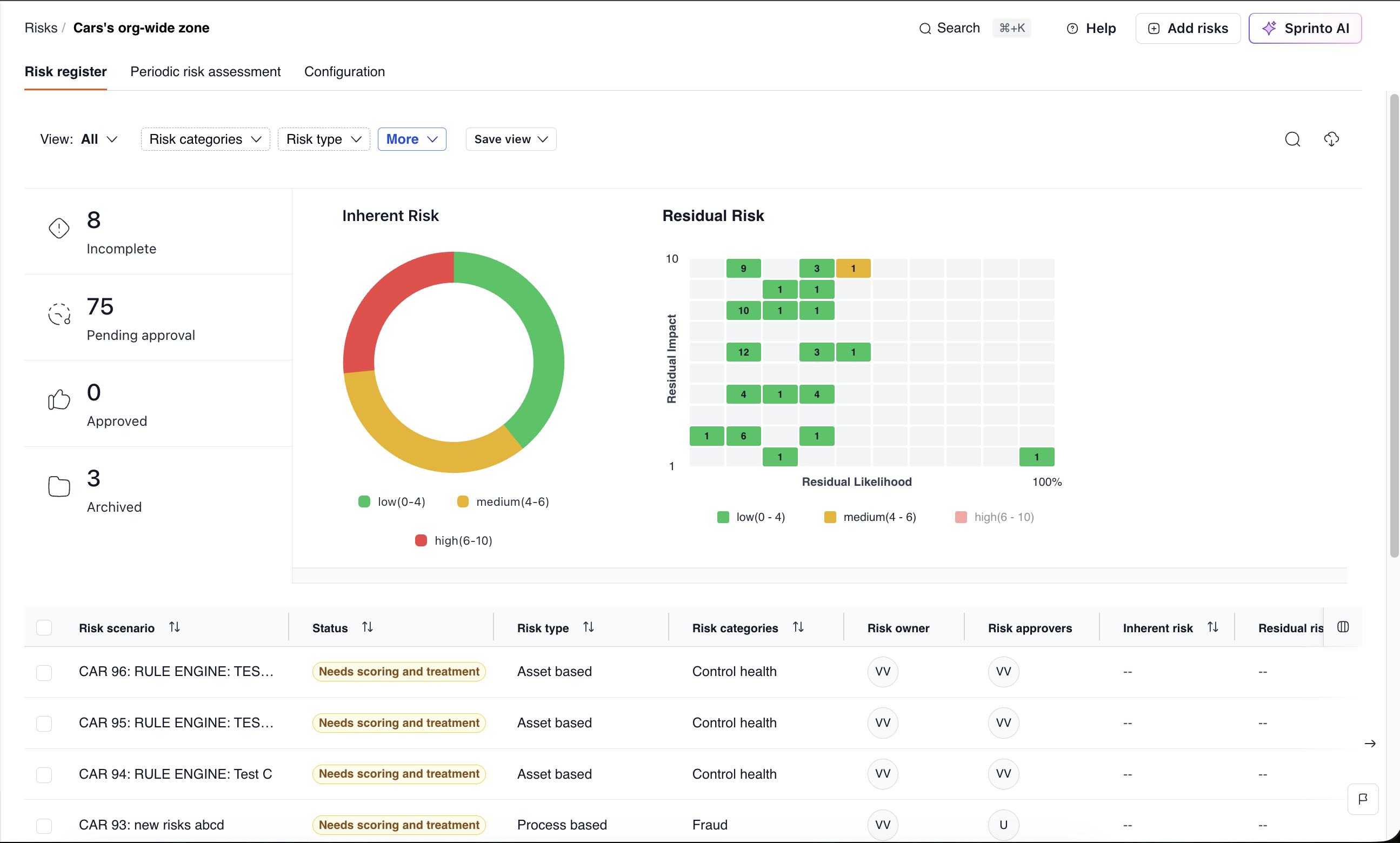
You can customise the risk charts displayed on the Risk register page to control how risk data is visualised across your organisation. Sprinto lets you configure up to three charts, allowing you to focus on the risk metrics that matter most.
The available charts include:
* **Inherent risk**
* **Residual risk**
* **Effective residual risk score**
Each chart can be enabled, disabled, and customised independently.
***
#### What you can customise
For each risk chart, you can:
* Choose the **risk formula** to visualise (Inherent Risk, Residual Risk, or Effective Residual Risk Score).
* Select the **chart type**:
* **Heatmap**
* **Donut**
* **Continuous**
* Control whether the chart is **shown or hidden** on the Risk register dashboard.
***
#### How to customise risk charts
1. Log in to the Sprinto dashboard and go to **Risks**.
2. Open the required **Risk register**.
3. Navigate to the **Configuration** tab.
4. Select **Visualisation**.
A side panel opens showing all available charts. You can configure up to **three charts** at a time.
5. Use the **toggle** next to a chart to enable or disable it.
6. Select the **edit (pencil) icon** to customise the chart.
In the **Edit visualisation** panel:\
7\. Choose the **formula to visualise** (for example, Inherent Risk or Residual Risk).\
8\. Select the **chart type**:
* Heatmap
* Donut
* Continuous
9. Configure the X and Y axis for Heatmap chart type.
10. Set the minimum and maximum values for both axes if you are using the continuous heatmap.
11. Customise the colours for all the metrics.
9. Review the live preview.
10. Select **Save**.
11. Ensure the chart toggle is turned on.
Once enabled, the chart appears on the **Risk register** page above the risk data table.
***
#### Examples
* If you want to analyse how risks are distributed by severity, you can configure an **Inherent Risk donut chart** to quickly see how many risks fall under low, medium, or high categories.
* If you need deeper insight into likelihood versus impact, you can enable a **Residual Risk heatmap** to visually identify high-impact, high-likelihood risks that require attention.
***
#### Key notes
* You can display **up to three charts** at a time on the Risk register dashboard.
* Charts must be **saved and toggled on** to appear on the dashboard.
* Changes apply at the **risk register level**, not globally across all registers.
* You can use the **Continuous heatmap** if you want accurate readings for your metrics.
***
### Saved filter views
Saved filter views let you create and reuse customised risk register views based on specific filters such as risk categories, risk type, ownership, status, and other attributes. This helps teams quickly switch between commonly used perspectives without reapplying filters every time.
You can save these views with custom names and access them anytime from the **View** dropdown in the risk register.
#### What you can do with saved filter views
Using saved filter views, you can:
* Filter risks by **risk category** (for example, Control health, Fraud)
* Narrow down risks by **risk type** (such as Process-based or Asset-based)
* Apply additional filters from **More**, including risk owner, approver, treatment decision, status, scores, and custom fields
* Save the configured view with a personalised name
* Quickly switch between saved views from the **View** selector
Saved views are available to all users, making it easier for teams to stay aligned on commonly used risk perspectives.
***
#### How to create and use a saved filter view
1. Go to **Risks** and open the required **Risk register**.
2. Use the filters at the top of the page (Risk categories, Risk type, and **More**) to customise the view.
3. Once the filters are applied, click **Save view**.
4. Enter a name for the view and click **Save**.
5. To access the saved view later, open the **View** dropdown and select the saved filter view.
The risk register will automatically update to show the saved configuration.
***
### Restrictions on Editing
* You cannot edit uploaded risk assessment documents.
* Risks under final review by senior management are locked until the review is completed.
* Audit logs and historical scoring events are view-only.
***
### Customise Risk Field Ordering
You can customise the order in which fields appear in the **Risk Profile** section of a Risk Register. This helps prioritise the information most relevant to your risk management process and ensures a consistent viewing experience for all users.
For example, you can move frequently used fields such as **Risk Owner**, **Risk Source**, or **Risk Categories** higher in the profile, while placing custom or less frequently referenced fields lower in the layout.
#### Reorder risk profile fields
1. Go to **Risks** and open the required **Risk Register**.
2. Select the **Configuration** tab.
3. In the **Risk field ordering** section, select **Manage**.
4. In the drawer that opens, drag and drop fields into the desired order.
5. Select **Save changes**.
The updated ordering is applied to all risks within the selected Risk Register. Both standard and custom fields can be reordered to match your preferred workflow.
---
# Agent Instructions
This documentation is published with GitBook. GitBook is the documentation platform designed so that both humans and AI agents can read, navigate, and reason over technical content effectively. Learn more at gitbook.com.
## Querying This Documentation
If you need additional information that is not directly available in this page, you can query the documentation dynamically by asking a question.
Perform an HTTP GET request on the current page URL with the `ask` query parameter, and the optional `goal` query parameter:
```
GET https://docs.sprinto.com/risks/dashboard-actions/edit-a-risk.md?ask=&goal=
```
`ask` is the immediate question: it should be specific, self-contained, and written in natural language.
`goal` is optional and describes the broader end goal you are ultimately trying to accomplish on behalf of the user. GitBook uses it to tailor the answer towards what is most useful for that goal.
The response will contain a direct answer to the question and relevant excerpts and sources from the documentation.
Use this mechanism when the answer is not explicitly present in the current page, you need clarification or additional context, or you want to retrieve related documentation sections.