> For the complete documentation index, see [llms.txt](https://docs.sprinto.com/llms.txt). Markdown versions of documentation pages are available by appending `.md` to page URLs; this page is available as [Markdown](https://docs.sprinto.com/policies/dashboard-actions/create-policies-and-documents.md).
# Create Policies and Documents
Learn how to create and upload policies, procedures, and supporting documents in Sprinto.
Sprinto provides multiple ways to create and manage your organisation’s documentation. You can generate policies using prebuilt templates, draft them manually, upload files, or import documents from your existing repositories like Confluence or SharePoint. All policies are created from the **All policies & docs** tab in the Policies module.
***
### **Before you begin**
Ensure that:
* You have the required role (Administrator or InfoSec Owner) to create documents.
* At least one compliance framework is enabled in your Sprinto account to access the document library and framework-specific templates.
***
### **Ways to create or upload documents**
You can create documents in Sprinto using any of the following methods.
***
#### **1. Write from scratch using the built-in editor**
1. Log in to the Sprinto Dashboard and navigate to **Policies**.
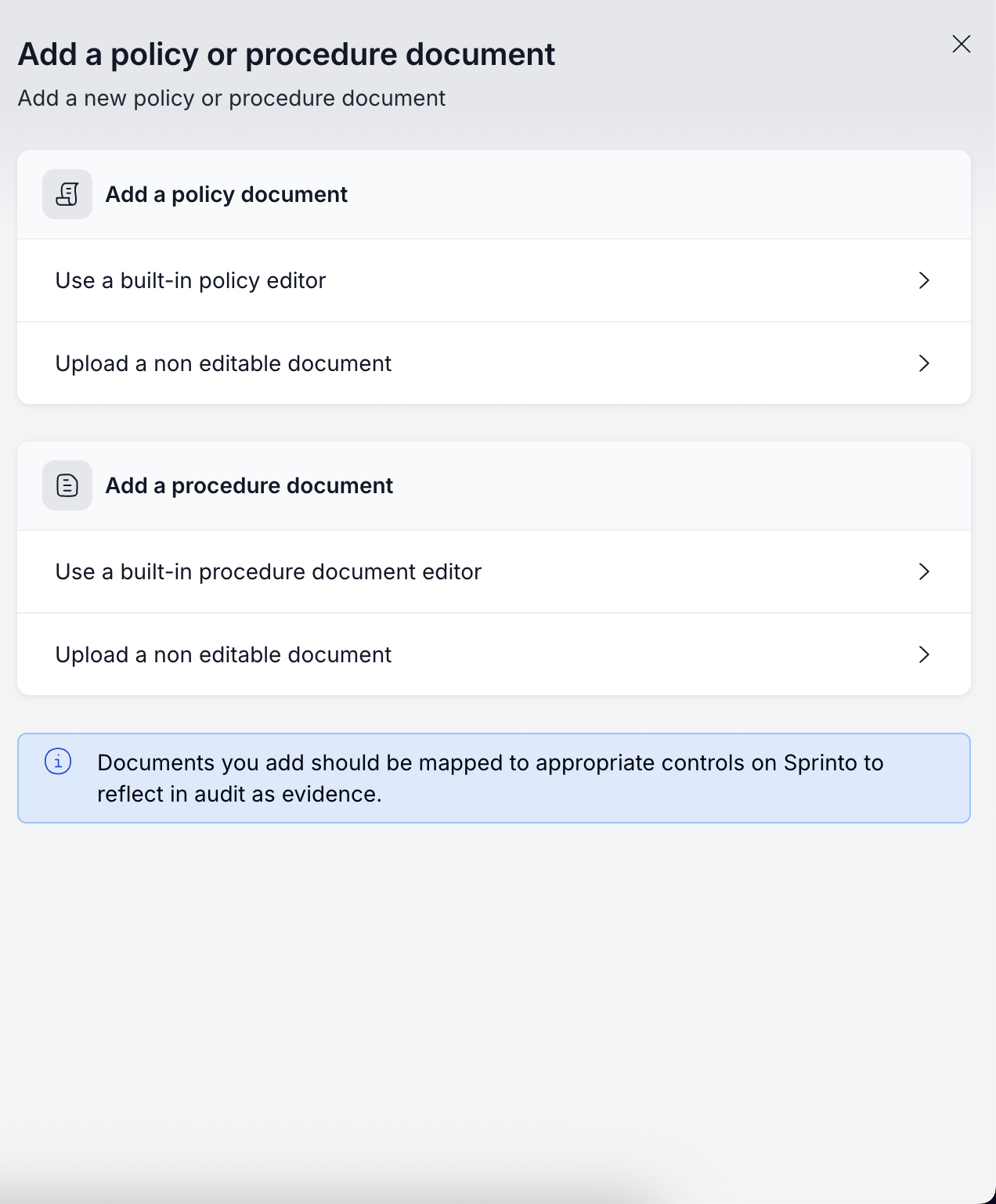
2. Click **Add documents** > **Policies or procedures**.
3. Choose **Use a built-in policy editor** or **Use a built-in procedure editor**.
4. In the editor, enter a **Name of the document**.
5. Draft your content using the rich text formatting toolbar.
6. Assign an approver.
7. Click **Add document**.
{% hint style="info" %}
This option is ideal for creating custom policies that do not follow a predefined template.
{% endhint %}
***
#### **2. Upload a non-editable document (PDF)**
1. Click **Add documents** > **Policies or procedures**.
2. Choose **Upload a non-editable document**.
1. Select the PDF file from your computer.
2. Enter the document name and assign an approver.
3. Click **Add document**.
{% hint style="info" %}
Uploaded PDFs cannot be edited in Sprinto. To make changes, you must re-upload the file.
{% endhint %}
***
#### **3. Select from library**
If your account has an enabled framework that supports document templates, you can select from Sprinto’s internal library.
1. Click **Add documents** > **Other documents**.
2. If visible, click **Select from library**.
3. Tick one or more documents from the list (e.g. *PCI Charter*, *ISMS Roles & Responsibilities and so on*).
4. Click **Add document**.
{% hint style="info" %}
This option is only enabled if you have a framework that requires or supports the selected documents.
{% endhint %}
***
#### **4. Add a custom document**
To add other types of compliance-related documents:
1. Click **Add documents** > **Other documents**.
2. Choose **Add a custom document**.
3. Select one of the following options:
* **Upload file** (.pdf, .xlsx, .docx, .csv)
* **Write on Sprinto** (opens the rich text editor)
4. Enter the document name and assign an approver.
5. Click **Add document**.
***
#### **5. Sync from Confluence or SharePoint**
If your policies are maintained in Confluence or SharePoint:
1. Click **Add documents**.
2. Under the **Sync** section, choose either:
1. **Sync from Confluence**
1. Select **I have the credentials** check box.
2. Click **Connect Confluence**.
3. Enter your **Confluence domain**, **Username** and **API token**.
4. Click **Connect Confluence**.
2. **Sync from SharePoint**
1. Select the **I have admin access to my Sharepoint account** check box.
2. Click **Connect to Sharepoint**.
3. In the pop-up that appears, select the OAuth option of your preference.
4. Enter your credentials and click **Connect**.
3. Ensure your documents are labelled correctly (e.g. `sprinto-policies`, `sprinto-procedures`).
{% hint style="info" %}
Synced documents are imported as non-editable PDFs and appear in **Draft** status.
{% endhint %}
***
### **Next steps**
After creating a policy or document:
* It appears under the **Draft** section.
* You can edit it, assign reviewers, and send it for approval.
* Once approved, it becomes **Active** and can be acknowledged by employees.
---
# Agent Instructions
This documentation is published with GitBook. GitBook is the documentation platform designed so that both humans and AI agents can read, navigate, and reason over technical content effectively. Learn more at gitbook.com.
## Querying This Documentation
If you need additional information that is not directly available in this page, you can query the documentation by asking a question.
Perform an HTTP GET request on the following URL with the `ask` and `goal` query parameters:
```
GET https://docs.sprinto.com/policies/dashboard-actions/create-policies-and-documents.md?ask=&goal=
```
`ask` is the immediate question: it should be specific, self-contained, and written in natural language.
`goal` is what the user is ultimately trying to achieve, the reason they need the answer. Sharing it helps GitBook give you a better, more relevant answer. A goal is most helpful when it describes the outcome the user wants rather than restating the question. For example, with `ask=how do I create an API token`, a goal like `automate deployments from our CI pipeline` lets GitBook tailor the answer to that use case.
The response will contain a direct answer to the question and relevant excerpts and sources from the documentation.
Use this mechanism when the answer is not explicitly present in the current page, you need clarification or additional context, or you want to retrieve related documentation sections.