> For the complete documentation index, see [llms.txt](https://docs.sprinto.com/llms.txt). Markdown versions of documentation pages are available by appending `.md` to page URLs; this page is available as [Markdown](https://docs.sprinto.com/monitors/cloud-and-infrastructure-monitoring/azure/how-to-resolve-sprinto-check-for-monitoring-azure-load-balancer-health-probe-status.md).
# How to resolve Sprinto check for monitoring Azure Load Balancer health probe status
### About
Sprinto Check: Azure Load Balancer health probe status should be monitored
Azure Load Balancer enables high availability and network performance for applications. Monitoring the health probe status of your Azure Load Balancer is essential for ensuring reliable and efficient traffic distribution to backend resources.
### Purpose
The purpose of the Sprinto check for Azure Load Balancer health probe status is to monitor and alert on the status of health probes actively. This monitoring helps you:
* Reliable Traffic Distribution: Ensure that the Load Balancer distributes traffic only to healthy backend resources.
* Proactive Issue Detection: Receive alerts if the health probe status indicates potential issues with backend resources, allowing you to address them proactively.
* Performance Optimization: Optimize the overall performance by maintaining the health and availability of backend resources.
### How to Resolve
To address this check, follow these steps to create a monitoring alert for Azure Load Balancer health probe status:
#### Before you Begin
* Ensure you have "Admin" access to the Azure account to create monitoring alerts.
* Log in to Sprinto as an administrator.
#### Creating Monitoring Alert
1. Log in to the[ Azure portal](https://portal.azure.com/) using your credentials.
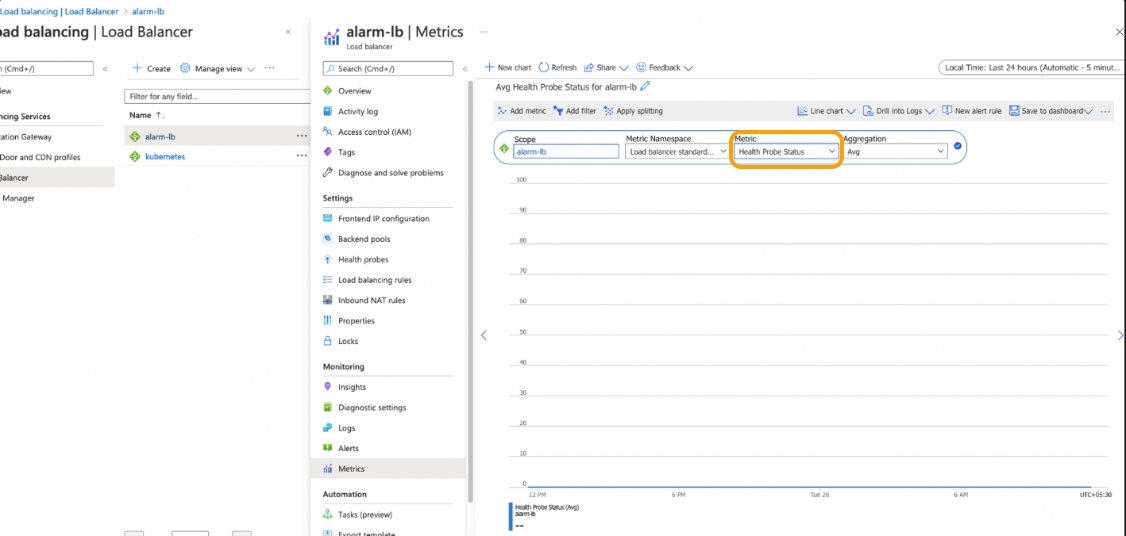
2. Navigate to the Azure Load Balancer resource you want to monitor.
3. In the left-hand menu, under Monitoring, select Metrics.
4. Under Metrics option, keep the existing namespace for Load Balancer.
5. Select the metric name as Health Probe Status.
6. From the top side, click New Alert Rule.
7. On the Configuration Signal Logic drawer, set up conditions to trigger alerts based on health probe status.
8. From the Create Alert Rule window, on the Details tab, set an appropriate alert rule name.
9. Finally, click Review + Create to create the alert.
Once the alert is created, Sprinto retrieves the change and sets the assigned check status to "Passing."
If you need any assistance with the Sprinto check, please get in touch with [Sprinto Support](mailto:www.support@sprinto.com).
---
# Agent Instructions
This documentation is published with GitBook. GitBook is the documentation platform designed so that both humans and AI agents can read, navigate, and reason over technical content effectively. Learn more at gitbook.com.
## Querying This Documentation
If you need additional information that is not directly available in this page, you can query the documentation dynamically by asking a question.
Perform an HTTP GET request on the current page URL with the `ask` query parameter, and the optional `goal` query parameter:
```
GET https://docs.sprinto.com/monitors/cloud-and-infrastructure-monitoring/azure/how-to-resolve-sprinto-check-for-monitoring-azure-load-balancer-health-probe-status.md?ask=&goal=
```
`ask` is the immediate question: it should be specific, self-contained, and written in natural language.
`goal` is optional and describes the broader end goal you are ultimately trying to accomplish on behalf of the user. GitBook uses it to tailor the answer towards what is most useful for that goal.
The response will contain a direct answer to the question and relevant excerpts and sources from the documentation.
Use this mechanism when the answer is not explicitly present in the current page, you need clarification or additional context, or you want to retrieve related documentation sections.